


RBI to Introduce India's First Polymer Currency Notes in FY28, Says Governor
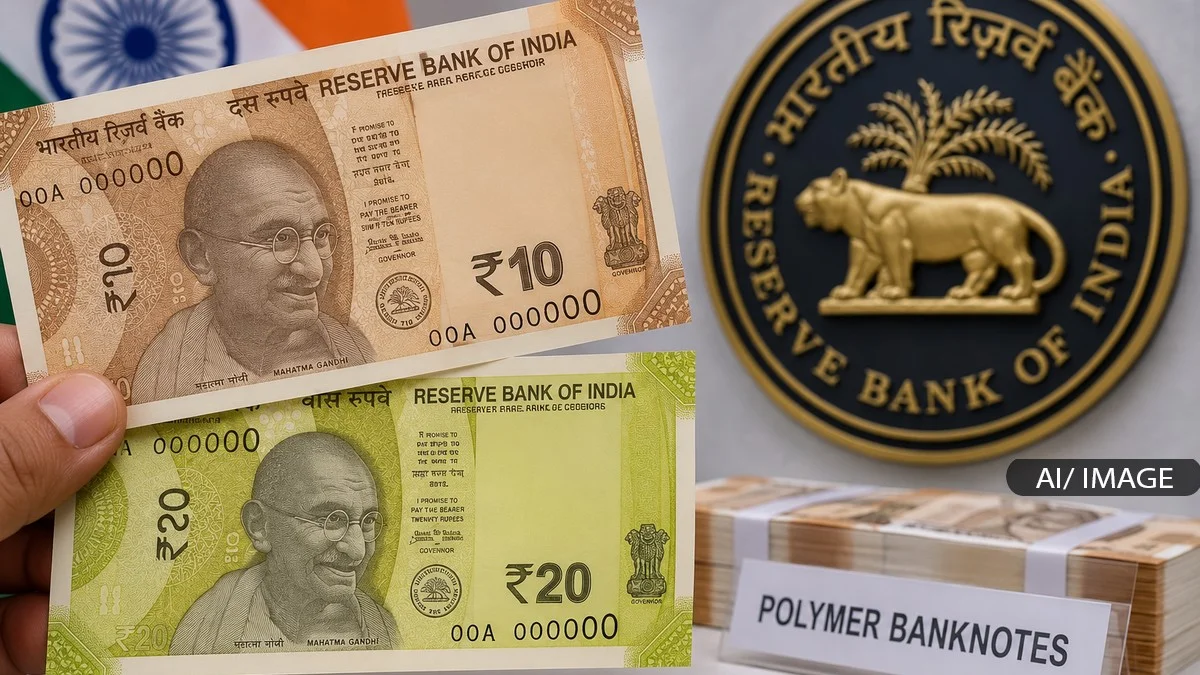
India could soon witness the introduction of its first polymer currency notes, with the Reserve Bank of India (RBI) aiming to launch them at the beginning of the 2027–28 financial year, subject to the successful completion of ongoing pilot projects.
Speaking after the Monetary Policy Committee (MPC) meeting on Wednesday, RBI Governor Sanjay Malhotra said the central bank is working towards introducing polymer banknotes if field trials produce satisfactory results. However, he emphasised that the initiative remains in the testing phase and that a nationwide rollout will depend entirely on the outcome of these evaluations.
The government has already authorised the RBI to print up to two billion polymer notes as part of the trial programme. The pilot project includes one billion Rs.10 notes and one billion Rs.20 notes.
The central bank has also clarified that there are no immediate plans to completely replace traditional paper currency. Both paper and polymer banknotes will continue to circulate as legal tender.
Why is RBI introducing polymer currency notes?
According to Malhotra, the main objective behind the initiative is to increase the lifespan of banknotes, particularly lower-denomination notes that are exchanged frequently and tend to deteriorate more quickly.
Studies conducted in several countries have shown that polymer banknotes can last two to four times longer than conventional paper notes. As a result, they are considered more suitable for currency denominations that experience heavy circulation.
The RBI governor also said the move would strengthen the country's currency production capacity as demand for cash continues to grow alongside the economy.
Pilot tests to determine future expansion
The central bank plans to evaluate the performance of polymer notes under India's diverse climatic conditions and within the country's extensive cash-handling network. A final decision on large-scale adoption will be taken only after these assessments are completed.
To support the initiative, Bharatiya Reserve Bank Note Mudran Private Limited (BRBNMPL), the RBI's wholly owned printing subsidiary, has issued a global tender for the procurement of polymer substrate sheets equipped with advanced security features. ALSO READ: Can India become the next semiconductor hub after Taiwan?
Lower costs and better security
The proposal comes at a time when the cost of maintaining India's currency supply continues to rise.
Over the past decade, nearly Rs.50 trillion worth of damaged and worn-out banknotes have been withdrawn from circulation. Industry estimates suggest that around Rs.5,000 crore is spent every year on currency security features.
Reports also indicate that, since the 2017 financial year, nearly 71 worn-out notes have been removed from circulation for every 100 new notes introduced into the system, highlighting the challenges associated with maintaining paper currency.
Apart from improved durability, polymer notes are expected to offer enhanced protection against counterfeiting, lower replacement costs and a smaller environmental footprint.
Strict procurement standards
The RBI has established strict eligibility requirements for companies participating in the procurement process. Suppliers must obtain government security clearances, comply with restrictions related to China and Pakistan, and demonstrate previous experience in supplying polymer banknote materials to central banks around the world.
Earlier, Minister of State for Finance Pankaj Chaudhary had informed Parliament that international studies strongly support the use of polymer banknotes because of their longer lifespan and greater durability.
For now, the RBI's polymer currency project remains at an early stage, but its successful implementation could mark one of the biggest changes to India's monetary system in recent decades.


