


West Bengal 2026: How Amit Shah Scripted BJP’s Historic Victory
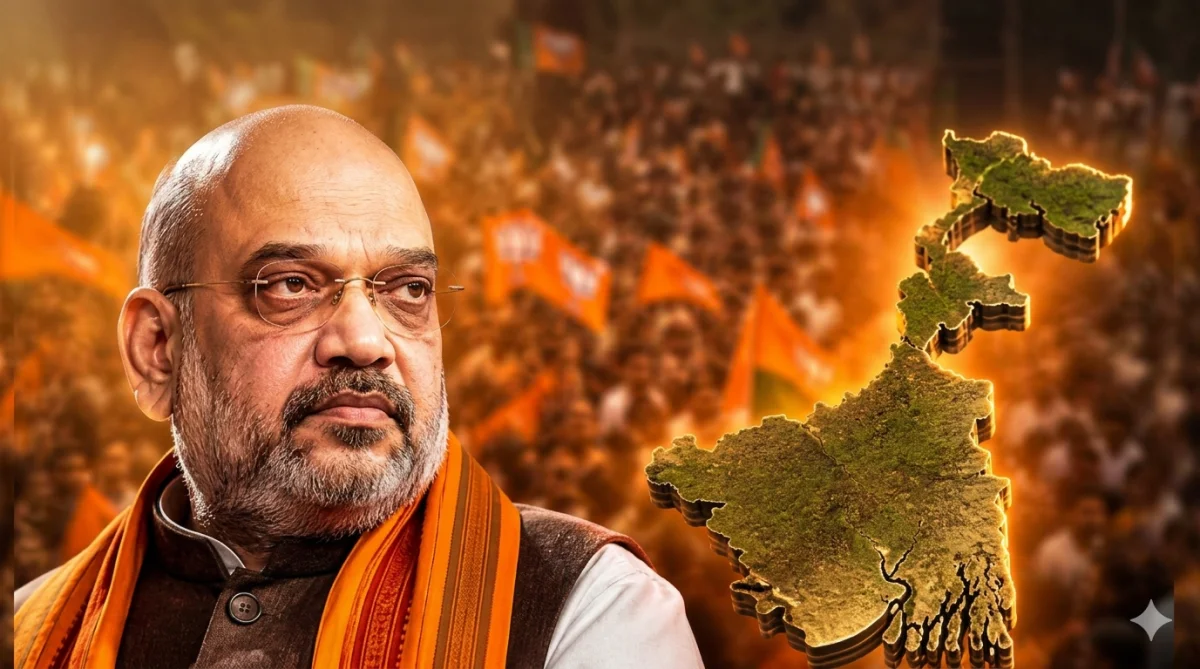
For the first time, the BJP is set to form a government in West Bengal—a long-cherished goal of both the party and the Rashtriya Swayamsevak Sangh. This milestone has largely been credited to Union Home Minister Amit Shah, often described as the BJP’s master strategist.
The journey began after the BJP came to power at the Centre in 2014. As party president, Amit Shah launched an ambitious mission to expand the BJP’s footprint in Bengal—a mission that now appears to have reached fruition. Trends and results indicate that the BJP is on course to secure a clear majority on its own.
The Architect of Victory
Amit Shah played a central role in shaping the BJP’s campaign in Bengal. In the run-up to voting, he camped in the state for nearly two weeks, addressing over 50 rallies and roadshows. Learning from the setbacks of the 2021 Assembly elections, Shah took direct control of the campaign and crafted a detailed roadmap for victory.
Amit Shah played a central role in shaping the BJP’s campaign in Bengal. In the run-up to voting, he camped in the state for nearly two weeks, addressing over 50 rallies and roadshows. Learning from the setbacks of the 2021 Assembly elections, Shah took direct control of the campaign and crafted a detailed roadmap for victory.
Strategy Beyond Rallies
Shah’s approach went far beyond public rallies. His focus was on meticulous election management. Under his leadership, the BJP set up a war room that connected operations from Kolkata to Delhi.
Shah’s approach went far beyond public rallies. His focus was on meticulous election management. Under his leadership, the BJP set up a war room that connected operations from Kolkata to Delhi.
He also deployed experienced leaders like Sunil Bansal, Mahesh Sharma, C.P. Joshi, and Sanjay Bhatia to coordinate at the grassroots level, ensuring a sharp and aggressive campaign strategy.ALSO READ: West Bengal 2026: BJP’s 5 Powerful Women Leaders — Will the Party Play the ‘Woman CM’ Card Against Mamata?
Booth-Level Precision
A key pillar of the BJP’s success was its focus on booth management. Workers were instructed to add 10–15 additional voters at each booth, which translated into thousands of extra votes per constituency. In a tightly contested election, these marginal gains proved decisive.
A key pillar of the BJP’s success was its focus on booth management. Workers were instructed to add 10–15 additional voters at each booth, which translated into thousands of extra votes per constituency. In a tightly contested election, these marginal gains proved decisive.
Three-Tier Campaign Strategy
Amit Shah’s Bengal plan operated on three levels:
Amit Shah’s Bengal plan operated on three levels:
- Organisational Rebuild: The BJP’s state unit was re-engineered down to the booth level, with 5–7 active workers per booth. Data analysis and AI-driven tools were used for targeted outreach.
- Issue Framing: The campaign positioned the TMC as synonymous with corruption and lawlessness.
- Voter Mobilisation: A mix of identity politics and development messaging was used to appeal to different voter groups.
The BJP also linked issues like CAA and NRC to cultural security, creating a strong emotional connect with sections of voters. ALSO READ: West Bengal Assembly Election 2026: 5 Key Reasons Behind BJP’s Landslide Victory
Ground-Up Expansion
Another major focus was grassroots expansion. Through large-scale recruitment, training, and micro-management of workers, the BJP built a presence even in areas where it previously had little influence.
Another major focus was grassroots expansion. Through large-scale recruitment, training, and micro-management of workers, the BJP built a presence even in areas where it previously had little influence.
Micro-Planning and Narrative Shift
Known for his sharp electoral instincts, Amit Shah implemented seat-by-seat strategies—deciding which issues to highlight, how to engage specific communities, and how to maximise booth-level impact.
Known for his sharp electoral instincts, Amit Shah implemented seat-by-seat strategies—deciding which issues to highlight, how to engage specific communities, and how to maximise booth-level impact.
He also shifted Bengal’s political discourse from purely local concerns to a broader national narrative, emphasising corruption, law and order, and the need for change. This reframing of the campaign played a crucial role in BJP’s success. ALSO READ: Bengal Elections 2026: Why BJP Win Could Trigger Turbulence


