


Police used 'excessive force', pellet guns on CJP protesters: Amnesty
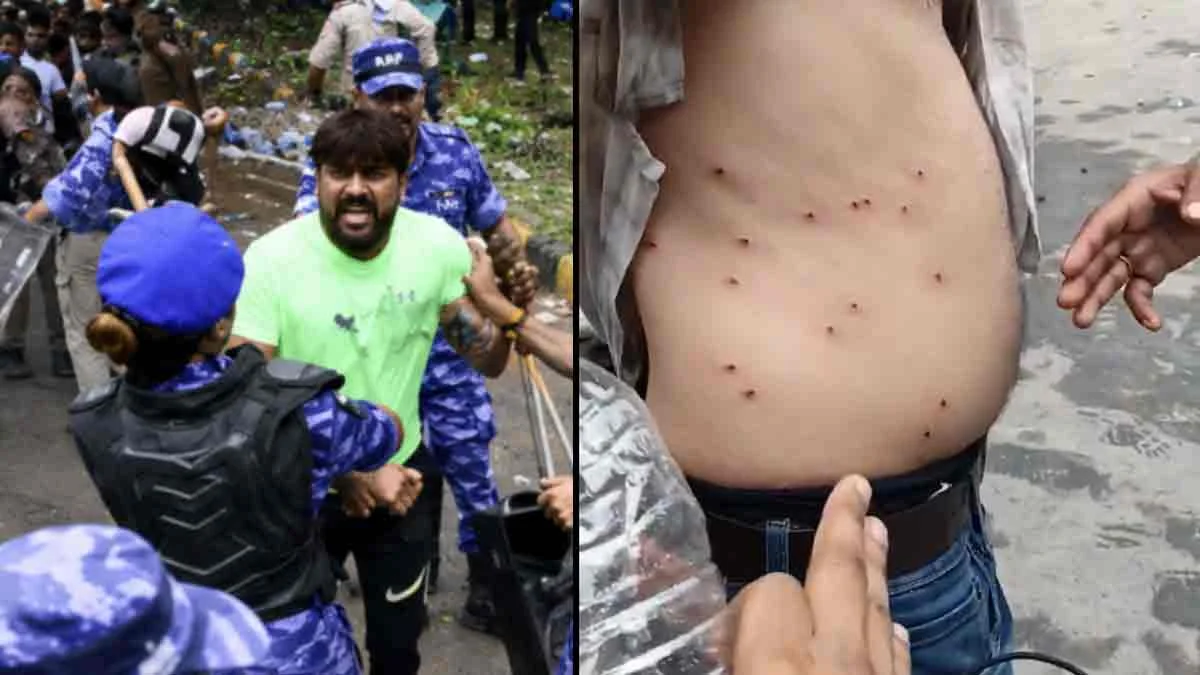
Indian police used excessive force — including pellet-firing shotguns, tear gas launchers, grenades, batons and electric shock devices — in their clampdown of July's youth-driven Cockroach protests, a new digital investigation published by human rights group Amnesty International on Monday alleged.
Amnesty said that its Evidence Lab had verified video and photographic evidence — along with witness testimony — to confirm the use of the weapons in Delhi and eastern India's Bihar state.
"The weapons were deployed in a manner that breached international law and standards and domestic policing guidelines," Amnesty said in a report that contradicts police claims.
Amnesty says pellet guns used
Amnesty also published an account of an anonymous protester who claimed to have sustained pellet injuries.
"I saw an officer standing roughly 300-400 metres away aiming the (pellet-firing) shotgun towards where I was standing. I started running in the opposite direction and that's when I got hit on my back, otherwise I would have been hit on my face and chest," Amnesty quoted the protester as saying.
The protester told the international human rights organization that doctors had confirmed that they were pellet injuries.
The Delhi police had earlier posted a statement on X deeming reports claiming the use of pellet guns against peaceful protesters as "completely false and misleading".
On Friday, opposition leader Rahul Gandhi reached a Delhi Police station with a 19-year-old protester who said he was wounded by pellets during the July 20 march.
Gandhi staged a sit-in with the protester outside the police station, demanding a police investigation into the shooting. The protester's case was subsequently registered by the police.
'State-sanctioned violence masked as crowd control,' Amnesty alleges
Aakar Patel, Chair of Board, Amnesty International India said in a statement that Indian authorities first "suppressed" the demonstrators right to protest with a communication blackout, barricading and transport disruptions.
"They then attempted to crush it with unnecessary or excessive use of force against peaceful protesters, including children. This heavy-handed response was state-sanctioned violence masked as crowd control. The continued impunity after a month is a testament to that," Patel said.
The protests, which were led by the viral satirical Cockroach Janta Party (CJP), were sparked by the leak of question papers for a highly-competitive national medical college entrance exam. The protests made India's then-education minister Dharmendra Pradhan step down.
The movement is seen as one the biggest challenges for Prime Minister Narendra Modi in his three terms in power.
The CJP movement has expanded to focus on unemployment and opportunities for young people.
What Delhi Police said about the use of force
The Delhi Police has denied the use of excessive force during the July 20 protest march to the Indian parliament that was met with violent police action, triggering allegations of police brutality.
Amnesty's report comes just days after the Supreme Court formed a high-powered enquiry committee to probe the allegations of violence by both police and demonstrators.
Police officials told the Indian top court last week that they used force only after the protests stopped being peaceful.
The Delhi police claimed that anti-social elements "masquerading as aggrieved students" got mixed with the thousands of protesters and caused "grievous injuries" to security forces.
The capital's police told the court that 240 personnel were injured in the clash with protesters.
The Delhi police asserted in the Supreme Court that it used "maximum restraint" while using only the "minimum required force" to control the protest.
Amnesty said that there were "isolated incidents of protesters throwing stones."
Amnesty probe singles out use of AK-type assault rifle on Bihar protesters
Amnesty International said that it had verified two videos filmed during the Cockroach movement protests in the eastern state of Bihar's Siwan on July 24, where a police officer is using an AK-type assault rifle against protesters.
"Firearms of this kind are designed to kill and, in the context of assemblies, may lawfully be used only to meet an imminent threat of death or serious injury to a specific individual, and only as an absolute last resort," the organization said, adding that it had found "no evidence any such threat existed."
The Bihar Police told the Supreme Court last Monday that one of their police constables "got trapped in the crowd during the protests and fired four rounds in the air, adding that no one was injured.
The Bihar Police agreed in its account to the court that AK-47 rifle was a "platoon-level weapon" used in special operations and not in crowd control situations.
The Bihar Police. however. maintained that it had not used excessive force. ALSO READ: Chaos During CJP March to Parliament: Police Use Tear Gas, Lathi Charge to Disperse Protesters (VIDEO)


