


Why Is Government Sticking to UPI Charges Despite Opposition? Decode 0.4% MDR Rule Above Rs. 2,000
India's Unified Payments Interface (UPI) is set for a major change from October 15, 2026, with a 0.4% Merchant Discount Rate (MDR) being introduced on specified Person-to-Merchant (P2M) transactions above Rs.2,000.
The move has triggered a debate over why charges are being reintroduced when UPI has been one of the key drivers of India's digital payments revolution. According to estimates cited in media reports, the new framework could generate around Rs.15,000 crore annually for participants across the payments ecosystem. Importantly, this amount is not government revenue; MDR is distributed among banks, payment apps and other payment-service participants.
So, what exactly is changing, why is the new framework being introduced, and how will the MDR work? Here is the issue explained in simple terms.
NPCI and the Government's New UPI Framework: What Has Changed?
The new framework can be understood through four key points:
1. UPI payments up to Rs.2,000 remain free
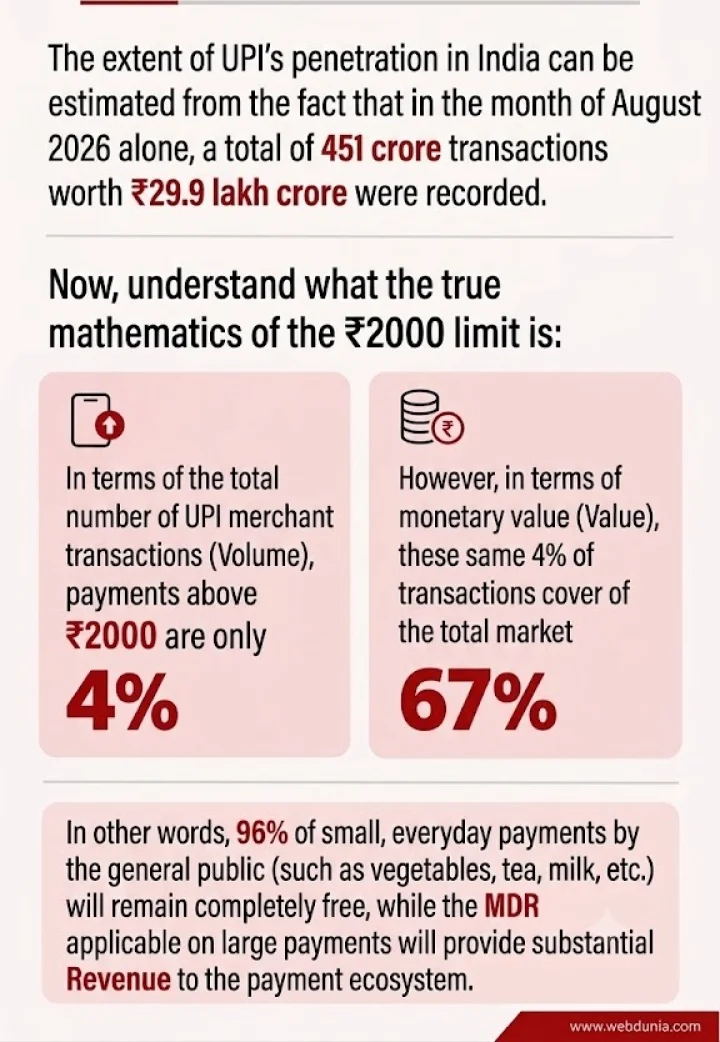
Person-to-Merchant UPI payments of up to Rs.2,000 will continue to remain outside the MDR regime. Person-to-Person (P2P) transactions, such as sending money to family or friends, will also remain completely free, irrespective of the amount. The government has said around 96% of P2M transactions will remain unaffected.
2. 0.4% MDR on specified payments above Rs.2,000
From October 15, merchants will have to pay an MDR of 0.4% on specified P2M UPI transactions above Rs.2,000. The charge will be capped at Rs.300 per transaction for payments of Rs.75,000 or more.
For example, an eligible Rs.10,000 UPI payment would attract an MDR of Rs.40, while a Rs.50,000 transaction would attract Rs.200.
3. Consumers will not be charged directly
The MDR is a charge on the merchant side, not a fee that consumers are required to pay for using UPI. Banks and payment providers have been advised to ensure that merchants do not pass the charge on to customers.
The government has also clarified that the MDR is neither a tax nor money collected by the government or NPCI. It is distributed among participants in the payment ecosystem to support the operation and expansion of UPI.
4. Certain merchants and sectors have exemptions or special rates
The new framework does not apply uniformly to every transaction. Small merchants meeting specified criteria are protected from the MDR, while sectors such as railways, fuel and telecom have separate fee structures. Transactions above Rs.75,000 are subject to the Rs.300 MDR cap.
The Rs.15,000-Crore Revenue Question: How Significant Is It?
The new MDR framework is expected to generate around Rs.15,000 crore a year. However, it is important to understand that this is ecosystem revenue rather than money going directly into the government's coffers.
The money will be distributed among various participants involved in processing UPI payments, including banks and payment application providers.
The broader argument from policymakers is that as UPI transaction volumes continue to grow, the ecosystem needs a more sustainable financial model to support infrastructure, cybersecurity and continued expansion.
From Zero MDR to the New 2026 Framework: The UPI Timeline
UPI's MDR journey has changed significantly over the past few years.
Before 2020
Merchant payments through digital payment systems carried MDRs before the government moved to make UPI transactions effectively free.
2020: Zero MDR introduced
In 2020, the government introduced a zero-MDR regime for UPI and RuPay debit card transactions to encourage digital payments and accelerate adoption.
Government incentive scheme
With banks and payment companies raising concerns over the cost of maintaining the rapidly expanding digital payments infrastructure, the government subsequently provided incentives to support the ecosystem.
2025: Government rejected reports of UPI charges
In June 2025, the Finance Ministry had described reports about plans to impose MDR on UPI transactions as false and misleading. The latest 2026 framework represents a significant change from that position.
2026: MDR returns for specified high-value merchant payments
Under the new framework, the zero-charge regime will continue for P2P transactions and most small-value merchant payments, while specified P2M transactions above ₹2,000 will attract a 0.4% MDR from October 15.
Why Is the Government Introducing the Charge?
The government and payment-industry stakeholders have pointed to the growing cost of maintaining and expanding the UPI ecosystem.
UPI has witnessed enormous growth in transaction volumes, increasing the need for investment in infrastructure, cybersecurity and reliability. The government has said the revised framework is intended to support the long-term sustainability of UPI while keeping everyday digital payments free for individuals and small merchants.
A senior government official also said there was no proposal to reconsider or roll back the 0.4% MDR framework after it was announced.
Three Major Concerns Raised Over the New UPI MDR
The decision has nevertheless triggered concerns among traders, economists and other critics.
1. Could people return to cash?
One concern is that introducing a cost for larger merchant transactions could affect the attractiveness of digital payments. Critics have warned that some customers or merchants could prefer cash if they perceive UPI payments as becoming more expensive.
However, the government maintains that everyday UPI usage will remain free because P2P transactions and most small-value merchant payments are exempt.
2. Impact on merchants
Merchants will bear the MDR on eligible transactions. Traders have expressed concerns that even a relatively small percentage could add to their operating costs, particularly for businesses that receive a large share of their payments digitally.
The government has advised banks and merchants not to pass the cost on to consumers.
3. Will merchants continue accepting UPI?
Another concern is whether some merchants, particularly smaller businesses, could try to discourage UPI payments to avoid the MDR.
The government has attempted to address this by protecting eligible small merchants and retaining zero charges for a large majority of P2M transactions. According to the Finance Ministry, around 96% of P2M transactions will remain unaffected by the new framework.
From October 15, the key question will be how merchants and consumers respond to the revised framework and whether the new MDR can provide a sustainable funding model without affecting the widespread adoption of digital payments.


