


Why Are We So Offended by Swear Words?
Is our language deteriorating, or is society simply hearing its own voice?
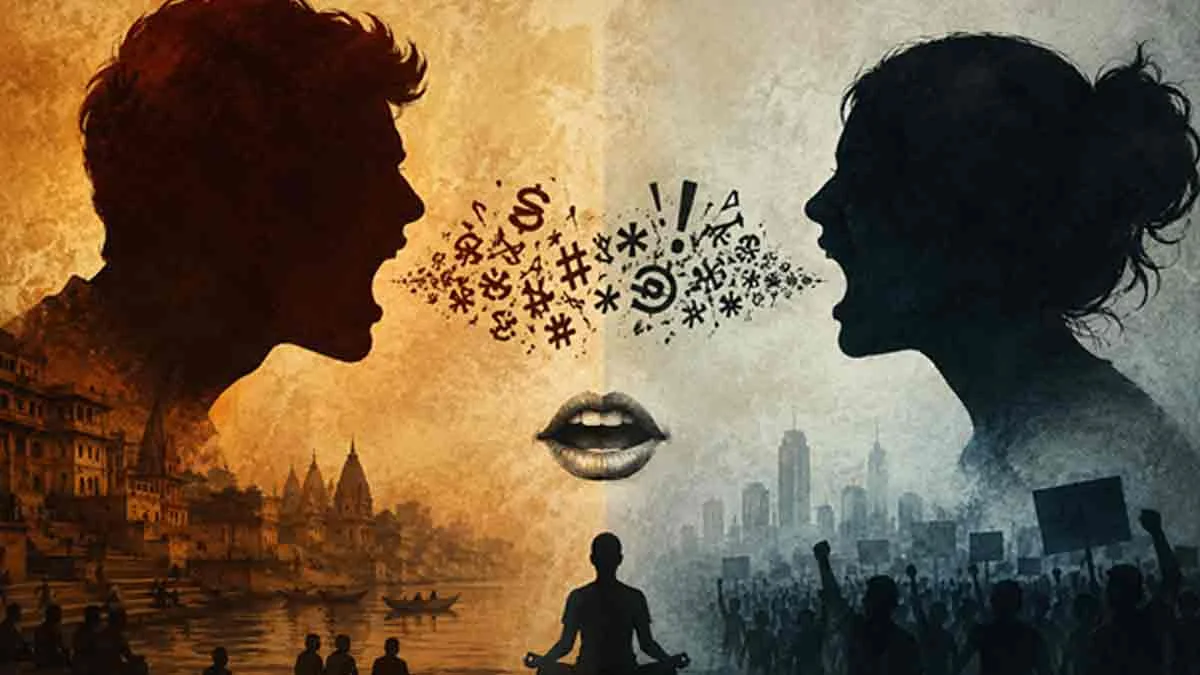
India seems to be having an unusually animated conversation about swear words. One week, the controversy revolves around a stand-up comedian. The next, it is an OTT series, a YouTuber, or the language of student protesters. Public outrage follows a familiar script: our culture is declining, civility is under attack, and language is losing its dignity.
But perhaps we are asking the wrong question.
The real issue is not whether profanity has suddenly become pervasive. The question is whether we are hearing, in public, a language that has always existed in private.
Profanity did not arrive with the internet
If one believes that swear words are products of social media, OTT platforms or Generation Z, one needs only to spend an evening at Banaras' Assi Ghat, visit village squares across North India, listen to conversations among truck drivers, observe the vocabulary of police stations, or attend a traditional North Indian wedding.
Profanity has been embedded in Indian folk culture for centuries—almost as deeply as folk songs themselves.
The difference is not historical, but technological. What once echoed through village courtyards now travels through algorithms.
This cultural complexity was memorably captured by Hindi novelist Kashinath Singh in Kashi Ka Assi. The language of Assi is unapologetically coarse, yet its profanity is not always abusive. It often conveys intimacy, camaraderie, humour and even resistance. In Banaras, a swear word may signify affection as much as aggression.
The same paradox exists in North Indian wedding traditions, where gaari songs—playful, often outrageous verbal exchanges directed at the groom's family—form an accepted ritual. Their purpose is not humiliation but the breaking of social awkwardness and the creation of familial ease.
In other words, Indian society has never viewed profanity solely as an instrument of insult. It has also functioned as folklore, humour and social theatre.
Interestingly, this is also the civilisation that gave us Kabir's timeless counsel:
"Aisi vaani boliye, man ka aapa khoy.
Auran ko sheetal kare, aaphun sheetal hoy."
"Speak in such a way that your ego dissolves; your words bring comfort to others and peace to yourself."
Indian linguistic culture has always accommodated these two seemingly contradictory traditions—refined speech and earthy irreverence.
The real contradiction lies elsewhere
The Hindi-speaking public presents one of the more fascinating linguistic paradoxes.
In formal spaces, it prides itself on impeccable civility. Public speeches begin with "Honourable", "Respected" and "Esteemed". Yet the same society often slips effortlessly into coarse, abusive language in homes, markets, traffic jams, political rallies, police stations and private conversations.
It is as though we speak two languages—one for the camera and another after it is switched off.
Rahim warned centuries ago:
"Rahiman jihva bawari, kahi gayi sarag paatal.
Aapu to kahi bheetar rahi, jooti khaat kapaal."
"The tongue speaks and retreats; it is the speaker who bears the consequences."
The warning survives in textbooks. It rarely survives in public life.
OTT platforms did not corrupt language. They removed its make-up.
A familiar criticism is that streaming platforms have vulgarised public discourse.
But have they?
Or have they merely documented the language society has always spoken behind closed doors?
In a country where abusive language has long been normalised in policing, electioneering and even legislative debate, assigning moral responsibility exclusively to entertainment platforms is intellectually convenient.
The mirror is often blamed for what belongs to the face.
What does profanity actually do?
To dismiss every swear word as mere vulgarity is to misunderstand language itself.
Profanity compresses emotion.
It can express rage, helplessness, frustration, contempt, satire and defiance in ways that more polite vocabulary often cannot.
Philosopher Ludwig Wittgenstein famously observed:
"The limits of my language mean the limits of my world."
If the language of a society is becoming more abrasive, it may be because the emotional landscape of that society has become more anxious, unequal or impatient.
This does not justify abuse.
But neither does it allow us to reduce every swear word to bad manners.
Language is rarely that simple.
Profanity and the politics of equality
There is another uncomfortable truth.
Across cultures, most swear words are deeply patriarchal. Women's bodies and relationships have historically been used as instruments through which men insult other men.
Language, in that sense, has mirrored structures of power.
Yet contemporary India is witnessing a noticeable shift.
Women increasingly use expressions once considered exclusively masculine.
Is this linguistic decline?
Or is it a claim to equality—even if through inherited, problematic vocabulary?
The answer is neither obvious nor singular.
As Mahadevi Varma argued in essence, the strongest chains are not always made of iron; many are forged through language itself.
The danger is not profanity. It is its normalisation.
None of this is an argument in favour of abusive speech.
A democracy cannot survive if insult replaces argument.
Satire strengthens public discourse.
Abuse weakens it.
The distinction matters.
When profanity becomes a substitute for thought, conversation gives way to noise.
That is where concern is justified.
Beyond the swear word
Every age invents its own vocabulary.
Today's language includes memes, reels, irony, sarcasm and profanity alongside poetry, scholarship and constitutional debate.
Disliking this evolution is perfectly legitimate.
Pretending it does not exist is not.
The more meaningful question, therefore, is not why society is swearing.
It is why society appears so angry.
Words do not emerge in a vacuum.
They are products of their political climate, social anxieties and cultural contradictions.
Perhaps profanity is not the finest expression of language.
But it remains one of society's most revealing diagnostic tools.
As George Orwell warned in Politics and the English Language, degraded language often reflects degraded public thinking, while careless speech can reinforce careless politics. The relationship between language and society is never accidental—it is reciprocal.
Before condemning the swear word, it may be worth examining the conditions that produced it.
Because language, however uncomfortable, remains society's most honest mirror.


