


Opposition MPs Exodus Explained: Is NDA Chasing a Two-Thirds Majority Through Operation Lotus 2.0?
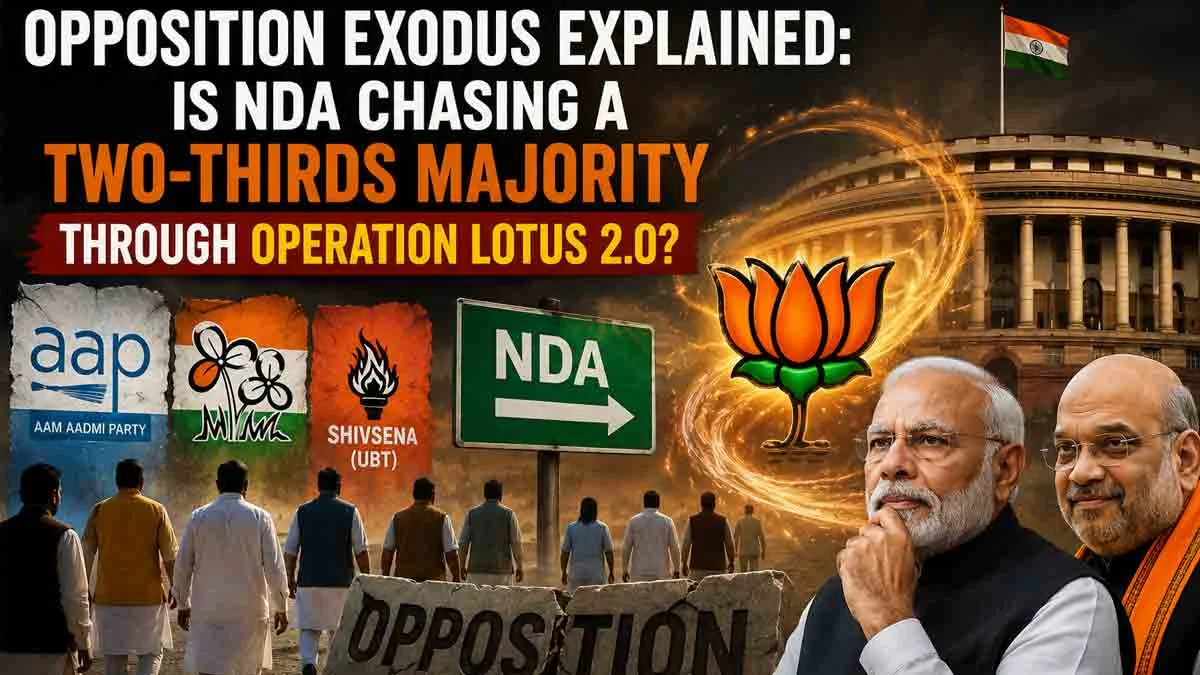
A wave of defections from opposition parties has sparked intense political debate, with analysts and opposition leaders questioning whether a broader strategy is being employed to help the NDA secure a crucial two-thirds majority in Parliament ahead of the upcoming Monsoon Session.
Over the past few weeks, several MPs from regional and opposition parties have either broken away from their parent organizations or announced support for group aligned with the ruling alliance. The developments have significantly altered the political landscape and raised questions about their impact on key legislation expected to be introduced in Parliament.
A Growing Trend of Political Defections
The political churn reportedly began with the Aam Aadmi Party (AAP), where a majority of its MPs chose to part ways with the party. Soon after, a major split emerged within the Trinamool Congress (TMC) in West Bengal.
The political churn reportedly began with the Aam Aadmi Party (AAP), where a majority of its MPs chose to part ways with the party. Soon after, a major split emerged within the Trinamool Congress (TMC) in West Bengal.
Following the state elections, a group of TMC MPs broke ranks and formed a separate bloc. To avoid disqualification under anti-defection provisions, the group subsequently merged with the Nationalist Citizens Party of India (NCPI) and extended support to the NDA.
The latest developments have unfolded in Maharashtra, where six of the nine Lok Sabha MPs from Shiv Sena (Uddhav Balasaheb Thackeray) are reportedly preparing to form a separate faction and align with Maharashtra Deputy Chief Minister Eknath Shinde's camp. Reports suggest that the rebel MPs have already submitted merger-related documents to the Lok Sabha Speaker.
Why Are MPs Switching Sides?
The scale and timing of these defections have led to speculation that they may be linked to the government's legislative priorities.
Political observers point out that during the previous Parliament session, the Centre introduced important bills related to delimitation and women's reservation. However, certain constitutional measures require a special majority, and the ruling alliance did not possess the numbers needed to ensure their passage.
The scale and timing of these defections have led to speculation that they may be linked to the government's legislative priorities.
Political observers point out that during the previous Parliament session, the Centre introduced important bills related to delimitation and women's reservation. However, certain constitutional measures require a special majority, and the ruling alliance did not possess the numbers needed to ensure their passage.
With Parliament's Monsoon Session approaching, discussions have intensified over whether the NDA is seeking to strengthen its numbers to facilitate the passage of future constitutional amendments and other significant legislative reforms.
The Anti-Defection Law and the Two-Thirds Formula
A key factor behind the current political realignments is India's anti-defection law.
Under the law, legislators who individually leave their parties can face disqualification. However, if at least two-thirds of a party's elected representatives split and merge with another group, they are protected from disqualification and can continue as members of Parliament.
A key factor behind the current political realignments is India's anti-defection law.
Under the law, legislators who individually leave their parties can face disqualification. However, if at least two-thirds of a party's elected representatives split and merge with another group, they are protected from disqualification and can continue as members of Parliament.
This provision has become central to the ongoing defections, as political groups seek legal pathways to realignment without risking their parliamentary membership.
Opposition Alleges Political Pressure
Opposition parties have strongly criticized the developments and accused the BJP of orchestrating the defections.
Opposition Alleges Political Pressure
Opposition parties have strongly criticized the developments and accused the BJP of orchestrating the defections.
Several opposition leaders have alleged that lawmakers are being pressured through investigative agencies or persuaded through political incentives to switch sides. They argue that the recent defections are not organic political decisions but part of a larger strategy to weaken opposition parties ahead of important parliamentary battles.
The BJP, however, has consistently rejected such allegations. The party maintains that leaders are joining its fold voluntarily because of ideological compatibility and confidence in the leadership of Prime Minister Narendra Modi.
What It Means for the Monsoon Session
What It Means for the Monsoon Session
As political equations continue to evolve, attention is now focused on the upcoming Monsoon Session of Parliament.
If the NDA succeeds in expanding its support base, it could significantly improve its ability to pass key constitutional and legislative measures. At the same time, the continuing exodus from opposition ranks may reshape alliance politics and redefine parliamentary dynamics in the months ahead.
If the NDA succeeds in expanding its support base, it could significantly improve its ability to pass key constitutional and legislative measures. At the same time, the continuing exodus from opposition ranks may reshape alliance politics and redefine parliamentary dynamics in the months ahead.
Whether these defections are part of a coordinated "Operation Lotus 2.0" or simply a reflection of changing political loyalties remains a matter of intense debate. What is certain, however, is that the battle for numbers in Parliament is far from over.


