


Why do we fly kites on Makar Sankranti? The legends behind the tradition

Across India, kite flying is an integral part of Makar Sankranti celebrations, which is why the festival is also popularly known as the Kite Festival. While there is no single written mythological text that clearly explains the origin of this tradition, several religious beliefs and historical references are associated with it. Hindu scriptures and folklore mention two widely accepted legends linked to kite flying on Makar Sankranti.
1. The legend of Lord Ram and Indralok
One of the most popular folk legends is associated with Lord Ram. According to the Ramcharitmanas by Tulsidas and certain regional versions of the Ramayana, such as the Tamil Kamban Ramayanam, Lord Ram flew a kite for the first time on the day of Makar Sankranti.
One of the most popular folk legends is associated with Lord Ram. According to the Ramcharitmanas by Tulsidas and certain regional versions of the Ramayana, such as the Tamil Kamban Ramayanam, Lord Ram flew a kite for the first time on the day of Makar Sankranti.
It is believed that the kite soared all the way to Indralok, the celestial abode of Lord Indra. Jayant’s wife, the daughter-in-law of Indra, was captivated by the beautiful kite and caught it, wondering how graceful its owner must be.
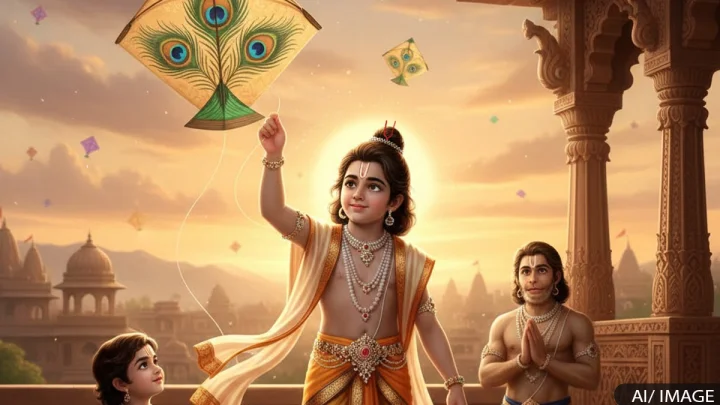
When the kite did not return, Lord Ram sent Hanuman to retrieve it. Upon reaching Indralok, Hanuman informed her that the kite belonged to Lord Ram. She agreed to return it on the condition that she be granted a glimpse of the Lord. It is believed that from this moment onward, the tradition of flying kites on Makar Sankranti began as a symbol of joy, devotion and celebration.
2. Bhishma Pitamah and the significance of Uttarayan
Another belief dates back to the Mahabharata. Bhishma Pitamah, who had the boon of choosing the time of his death, waited on his bed of arrows until the Sun entered Uttarayan, which coincides with Makar Sankranti.
Another belief dates back to the Mahabharata. Bhishma Pitamah, who had the boon of choosing the time of his death, waited on his bed of arrows until the Sun entered Uttarayan, which coincides with Makar Sankranti.
Uttarayan is considered the “day of the gods” and is believed to open the path to liberation (moksha). Kites soaring high in the sky are seen as a symbolic representation of the soul’s journey towards the Supreme Being and the resolve to rise above worldly limitations and attain spiritual heights. ALSO READ: Makar Sankranti 2026: Do THESE Zodiac-Wise Remedies for Wealth, Health and Success
Scientific and Health Significance
Vitamin D intake: During winter, the body becomes more vulnerable to various illnesses due to limited sunlight exposure. Around Makar Sankranti, the Sun’s rays are considered especially beneficial for health. Spending long hours outdoors while flying kites allows the body to absorb ample vitamin D, which is essential for strong bones, healthy skin and overall immunity.
Vitamin D intake: During winter, the body becomes more vulnerable to various illnesses due to limited sunlight exposure. Around Makar Sankranti, the Sun’s rays are considered especially beneficial for health. Spending long hours outdoors while flying kites allows the body to absorb ample vitamin D, which is essential for strong bones, healthy skin and overall immunity.
Protection from infections: According to Ayurveda, the warmth of the Sun during winter helps prevent skin-related infections and reduces stiffness in the body caused by cold weather. Regular exposure to sunlight is believed to aid natural healing and improve circulation.
Focus and mental well-being: Flying a kite requires sustained concentration and coordination. This deep focus helps calm the mind, enhances mental balance and promotes overall psychological well-being, making the activity both physically and mentally rejuvenating.
Disclaimer: The content provided here is based on beliefs and information only. Always consult a concerned expert.


